
Woman reads paper files at a desk

When saving for retirement, it’s important to review your account on a regular basis. A 401(k) statement provides updates on your account’s performance each quarter, and most plans allow on-demand statements so you can obtain information for a specific period of time. Your statement helps you stay updated on your financial progress toward retirement.

Below we’ve explained how to read and understand your 401(k) statement. While an example produced by Bankers Trust, powered by Empower is provided, the instructions for understanding sections of the statement can be applicable to statements produced by other providers.

How has my account changed?

Account activity during the period reflected includes:

  • Beginning balance
  • Payroll contributions
  • Change in value
  • Dividends or income
  • Expenses
  • Ending balance
  • Vested balance

Simply put, the vested balance is ownership of your total account balance. You are always 100% vested in any money you contribute to the plan, whether it’s Traditional pre-tax deferrals, Roth after-tax deferrals or any rollovers into the plan.

Any employercontributions you receive may be subject to a vesting schedule. This means you may need to participate in the plan for a set amount of time before you have full vesting (ownership) of those contributions.
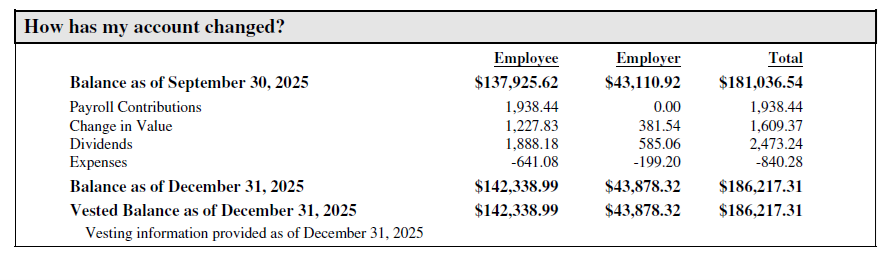
How has my account changed? Balance as of September 30, 2025 Employee: $137,925.62 Employer: $43,110.92 Total: $181,036.54 Payroll Contributions Employee: 1,938.44 Employer: 0.00 Total: 1,938.44 Change in Value Employee: 1,227.83 Employer: 381.54 Total: 1,609.37 Dividends Employee: 1,888.18 Employer: 585.06 Total: 2,473.24 Expenses Employee: -641.08 Employer: -199.20 Total: -840.28 Balances as of December 31, 2025 Employee: $142,338.99 Employer: $43,878.32 Total: $186,217.31 Vested Balance as of December 31, 2025 (Vested information provided as of December 31, 2025) Employee: $142,338.99 Employer: $43,878.32 Total: $186,217.31

How will my future contributions be invested?

This section may provide charts depicting contribution and account allocation. The contribution allocation chart shows how you want your payroll contributions invested. It may not necessarily be how your money is currently allocated. These may differ if you are investing payroll contributions in different funds or different amounts than the money already in your account.

This may also be an opportunity to rebalance your portfolio as investments are growing at different rates and may no longer suit your risk comfort level.
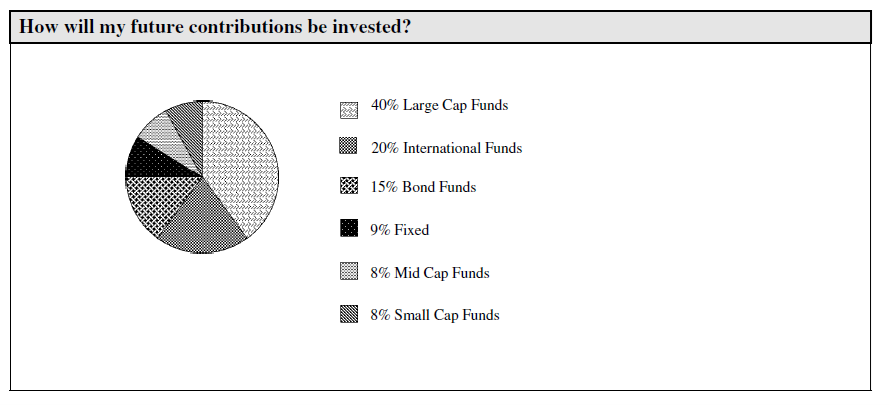
How will my future contributions be invested? 40% Large Cap Funds 20% International Funds 15% Bond Funds 9% Fixed 8% Mid Cap Funds 8% Small Cap Funds

How is my account being funded?

This breakdown usually includes the sources of money in the plan, such as your employee contributions and any employer contributions and activity that occurred during the period, along with information regarding your vesting percentages.

How is my account being funded? Employee Before Tax Beginning Balance: 137,925.62 Deposits: 1,938.44 Change in Value: 3,116.01 Withdrawals/Expenses/Transfers: -641.08 Ending Balance: 142,338.99 Percent Vested: 100% Vested Balance: 142,338.99 Employer Match Beginning Balance: 43,110.92 Change in Value: 966.60 Withdrawals/Expenses/Transfers: -199.20 Ending Balance: 43,878.32 Percent Vested: 100% Vested Balance: 43,878.32 Totals Beginning Balance: 181,036.54 Deposits: 1,938.44 Change in Value: 4,082.61 Withdrawals/Expenses/Transfers: -840.28 Ending Balance: 186,217.31 Vested Balance: 186,217.31

What are my lifetime income illustrations?

Most statements will include a projected account of monthly income that you may receive each month based on assumptions. Keep in mind, this projection is only an estimate and is based on several assumptions that may affect the estimates.
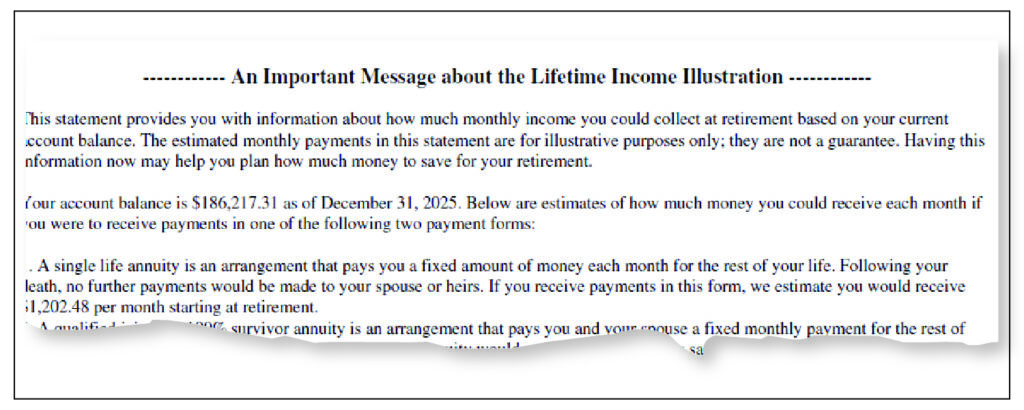
An Important Message about the Lifetime Income Illustration This statement provides you with information about how much monthly income you could collect at retirement based on your current account balance. The estimated monthly payments in this statement are for illustrative purposes only; they are not a guarantee. Having this information now may help you plan how much money to save for your retirement. Your account balance is $186,217.31 as of December 31, 2025. Below are estimates of how much money you could receive each month if you were to receive payments in one of the following two payment forms: A single life annuity is an arrangement that pays you a fixed amount of money each month for the rest of your life. Following your death, no further payments would be made to your spouse or heirs. If you receive payments in this form, we estimate you would receive $1,202.38 per month starting at retirement.

What is the rate of return on my retirement account?

This section represents the percentage gain or loss in your account’s value over this specific period.
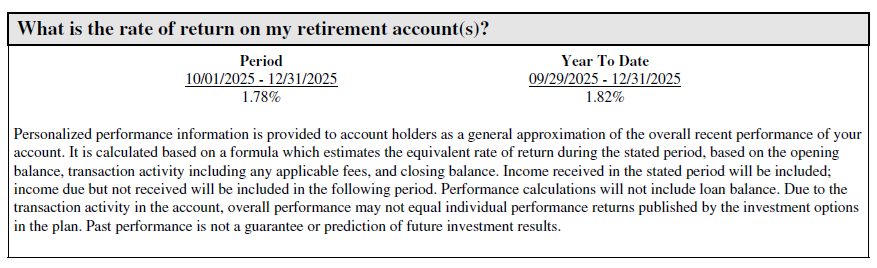
What is the rate of return on my retirement account(s)? Period 10/01/2025 - 12/31/2025: 1.78% Year To Date 09/29/2025 - 12/31/2025: 1.82% Personalized performance information is provided to account holders as a general approximation of the overall recent performance of your account. It is calculated based on a formula which estimates the equivalent rate of return during the stated period, based on the opening balance, transaction activity including any applicable fees, and closing balance. Income received in the stated period will be included; income due but not received will be included in the following period. Performance calculations will not include loan balance. Due to the transaction activity in the account, overall performance may not equal individual performance returns published by the investment options in the plan. Past performance is not a guarantee or prediction of future investment results.

How are the funds in the plan performing?

If you’re interested in evaluating other funds to invest in, most statements include information regarding fund performance in greater detail on the plan website.

Your 401(k) plan will provide income during retirement, so it’s important to stay well-informed on its progress. Consider consulting with a financial advisor to ensure you’re on the right track to reach your retirement savings goals.

Review your 401(k) statement quarterly and contact your plan administrator or relationship manager with any questions.


Headshot of Jen Carter

You may also be interested in…